
 The Charter of the French language and its regulations govern the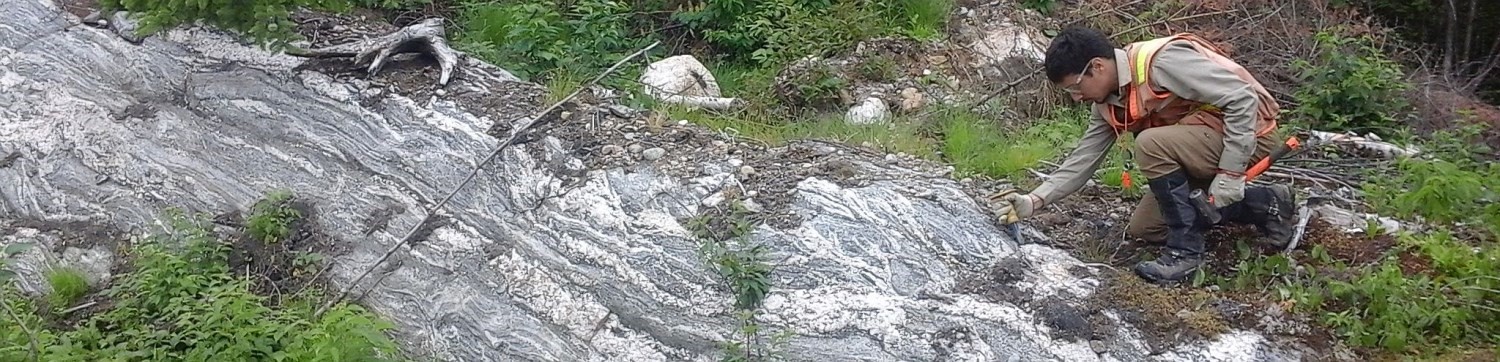

Last modification: 17 April 2025
| Author(s) | Moukhsil and Daoudene, 2019 |
| Methodology | Defined from geological survey |
| Geological(s) subdivision(s) | Grenville Province/Allochton |
| Main movement | Does not apply |
| Deformation style | Polyphase folding |
| Metamorphic facies (mean facies related to main deformation) | Granulites |
Background and Methodology
The Ministic Structural Domain was defined following geological mapping surveys conducted by Moukhsil and Daoudene (2019) in the Commissaires Lake area (NTS sheets 32A01, 32A02, 32A07 and 32A08), southwest of Lake Saint-Jean. The extension of this domain to the north (sheet 32A10) was defined by Moukhsil and El Bourki (2020) and to the west (sheet 32A03) by Talla Takam and Moukhsil (2022), following geological surveys in the Normandin and Fourche Lake areas, respectively.
Boundaries and Morphology
| Width | Maximum of 40 km along an E-W axis (sheets 32A02 and 32A03) |
| Length | Maximum of 78 km along a N-S axis (sheets 32A02, 32A07 and 32A10) |
| Orientation | N-S elongation in sheets 32A02, 32A03, 32A07 and 32A10 |
The morphology and extent of the Ministic Structural Domain are still poorly defined. The entire dataset presented in this record originated from the domain portion covered by sheets 32A02, 32A03, 32A07 and 32A10. High-definition magnetic imaging available in the area (Intissar and Benahmed, 2015) suggests that the Ministic Structural Domain extends further south and north in sheets 31P14, 31P15, 32A06 and 32A11. The Ministic Structural Domain forms a strip up to 40 km wide, N-S oriented and distributed along the western edge of sheets 32A02, 32A07 and 32A10, and along the eastern edge of sheet 32A03. It is delineated to the east by the Sainte-Hedwidge, Bouchette and Commissaires structural domains, to the NE by the Lac Rond structural domain, and to the west by the Windigo, Wenache and Cristal structural domains.
Stratigraphic Units Concerned
The stratigraphic units present in the Ministic Structural Domain are:
– Pope Plutonic Suite (mPpop2);
– Bardeau Plutonic Suite (mPbad);
– Barrois Complex (mPboi4);
– Wabash Complex (mPwab1 and mPwab2);
– Claire Gabbronorite (mPclr);
– Bonhomme Plutonic Suite (mPboh);
– Roc Suite (mPsro2);
– Léo Plutonic Suite (mPleo);
– Rhéaume Intrusive Suite (mPrhe2);
– Lachance Mangerite (mPlhc).
Structural Characteristics
In sheets 32A02, 32A03, 32A07 and 32A10, most outcrops of the Ministic Structural Domain show only one type of planar structural fabric, associated with a single deformation phase. This fabric is expressed by gneissosity, tectonometamorphic secondary mineral foliation and migmatitic banding, particularly in the Pope, Leo and Bardeau plutonic suites, as well as in the Barrois and Wabash complexes. Since the trajectory of structures in this fabric appears to be continuous from one outcrop to another, almost all measurements in the domain are attributed to Sn. The age of the associated Dn deformation phase is ≤1.2 Ga (see section “Chronological Markers”). In the event that structural fabrics associated with at least one earlier deformation phase (i.e. Dn-1) could later be identified in the Ministic Structural Domain, it was agreed to match the Sn foliation to S2 of “geofiches”.
❯ Main Fabrics
 The Sn planar fabric dominates the Ministic Structural Domain architecture in sheets 32A02, 32A03, 32A07 and 32A10. This fabric is expressed in different ways, but it is generally well developed in the Pope, Leo and Bardeau plutonic suites, as well as in the Barrois and Wabash complexes. In most intrusive rocks of the Pope and Bardeau plutonic suites, gneissosity is visible in alternating pinkish and pink-grey centimetric bands, respectively poor and rich in ferromagnesian minerals. In the Barrois and Wabash complexes, the Sn foliation is underlined by ubiquitous migmatitic banding in paragneiss. This banding consists of alternating whitish or slightly pink mobilisate bands and greyish ones usually composed of mesosome. Mobilisate bands commonly have thin fringes almost exclusively composed of biotite along their edges, one of the characteristics that could be interpreted as evidence of in situ partial melting of the rock.
The foliation’s attitude within the Léo and Bonhomme plutonic suites follows the edges of mangeritic intrusions. In other words, the foliation trajectory in these intrusions is concentric. Regionally, this foliation also appears to be concordant to the Sn foliation of the Bardeau Plutonic Suite (host rock). This implies that measurements from the Léo and Bonhomme plutonic suites are associated with the Dn deformation phase. Nevertheless, nothing excludes that this concentric foliation developed when intrusions were emplaced, which, moreover, could be contemporaneous with the Dn deformation. In any case, the foliation in the Léo and Bonhomme plutonic suites is variably developed. In fact, some outcrops show penetrative and continuous foliation marked by the orientation of ferromagnesian mineral clusters in a preferential plane, while other outcrops show very well-developed gneissosity.
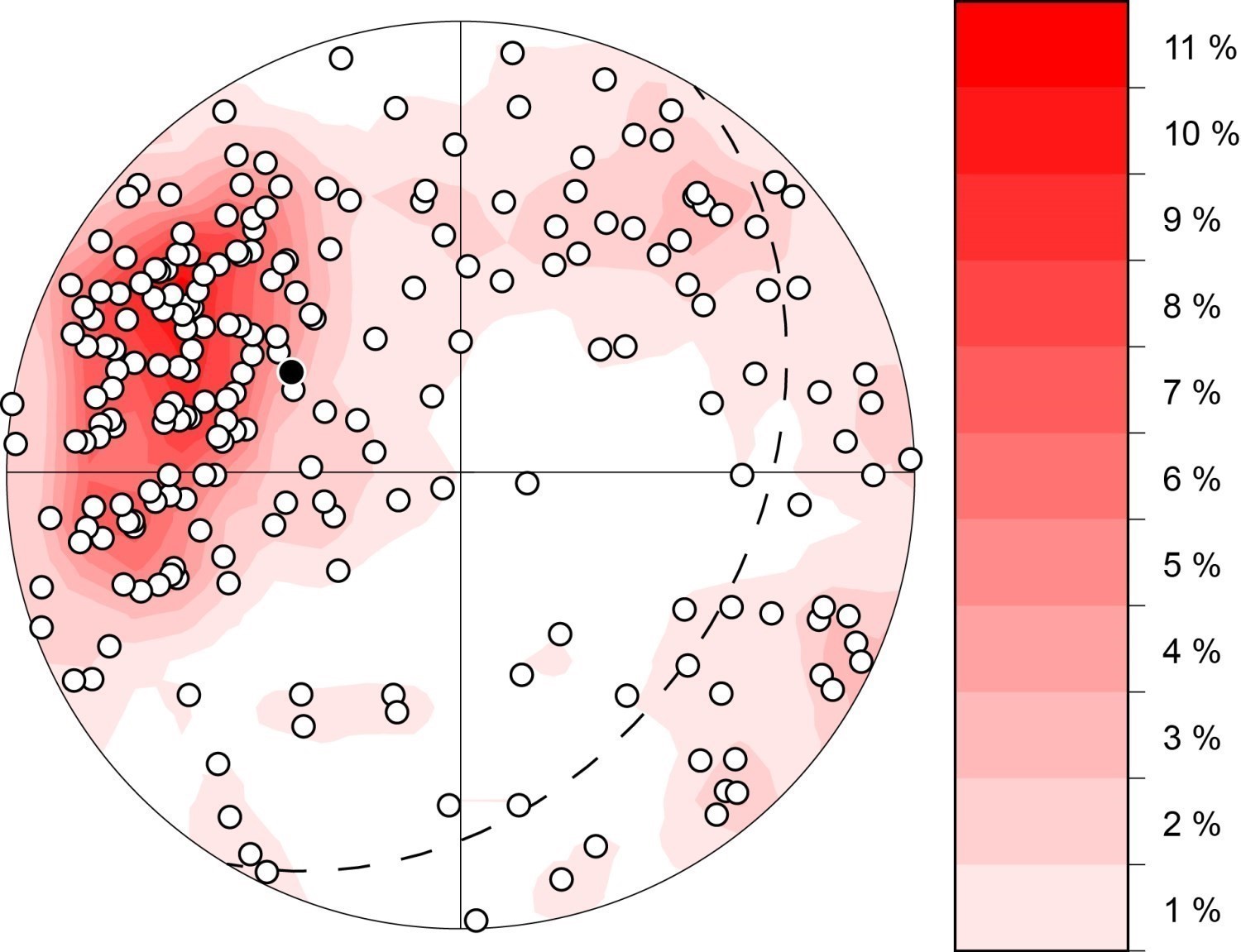
In sheets 32A02, 32A03, 32A07 and 32A10, Sn foliation measurements allow for the calculation of an average plane with an azimuth of 12° and a 51° dip to the east. Nevertheless, although the stereographic projection of Sn poles highlights a dominant group distributed in the W to WNW area of the canvas, the variability is significant in both orientation and dip. This may be explained by folding of the Sn foliation on a regional scale. This hypothesis is supported by the attitude of the Sn foliation map trajectory.
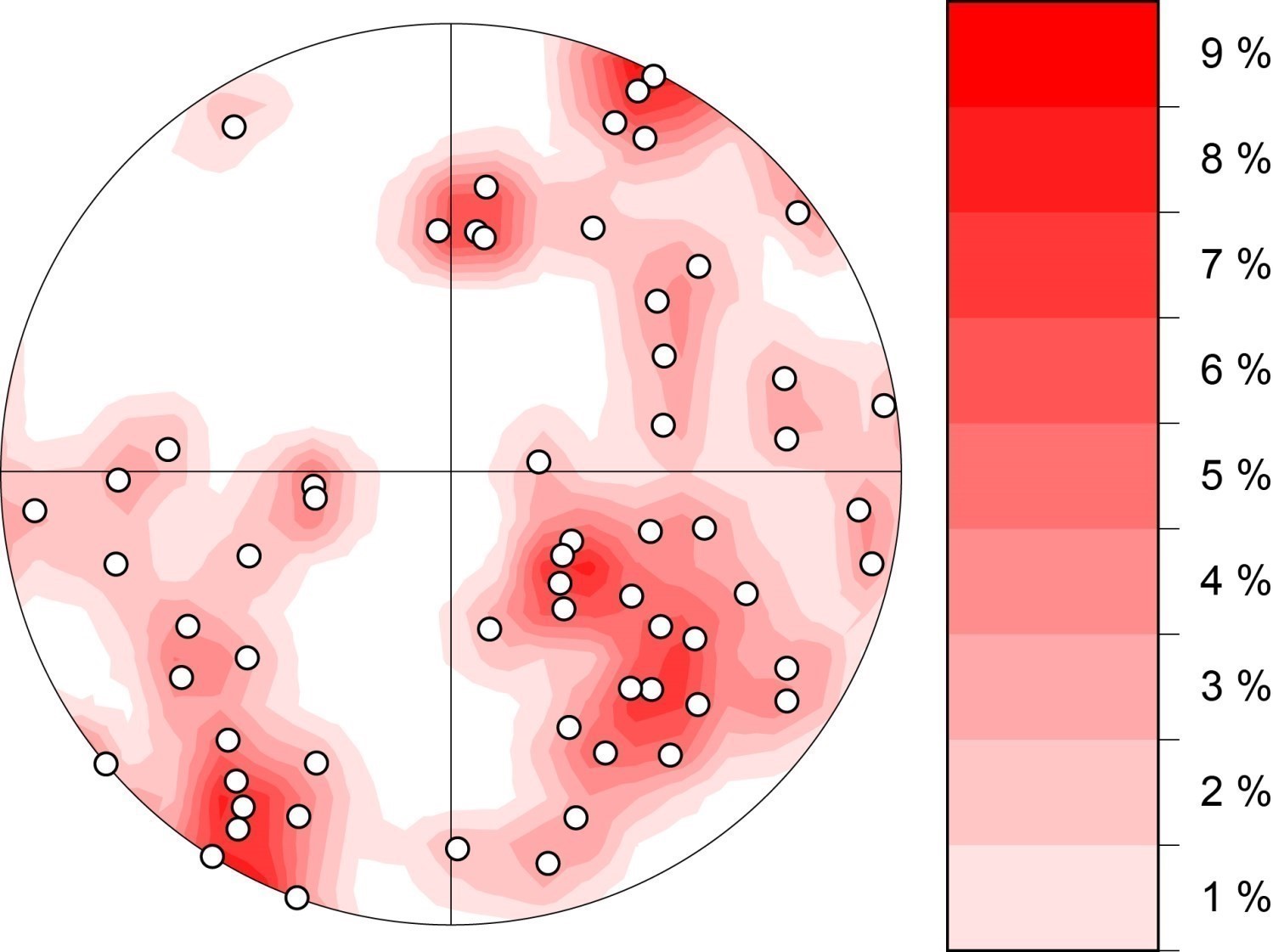
The Sn foliation carries an Ln lineation whose attitude is highly variable and difficult to interpret. In fact, this variability would be the result of folding of the Sn foliation.
| Main Fabric | Type of Fabric | Direction (°) | Dip (°) | Number of Measurements | Comments |
| Foliation Sn | Secondary tectonometamorphic mineral foliation, gneissosity, migmatitic banding | 12 | 51 | 577 | 222 measurements from sheets 32A02, 32A07 (Moukhsil and Daoudene, 2019), 229 measurements from sheet 32A10 (Moukhsil and El Bourki, 2020) and 126 measurements from sheet 32A03 (Talla Takam and Moukhsil, 2023) |
| Lineation Ln | Secondary mineral lineation (tectonometamorphic), stretch lineation | – | – | 196 |
62 measurements from sheets 32A02 and 32A07 (Moukhsil and Daoudene, 2019), 88 measurements from sheet 32A10 (Moukhsil and El Bourki, 2020) and 46 measurements from sheet 32A03 (Talla Takam and Moukhsil, 2023). The variability is very significant. |
❯ Other Fabrics
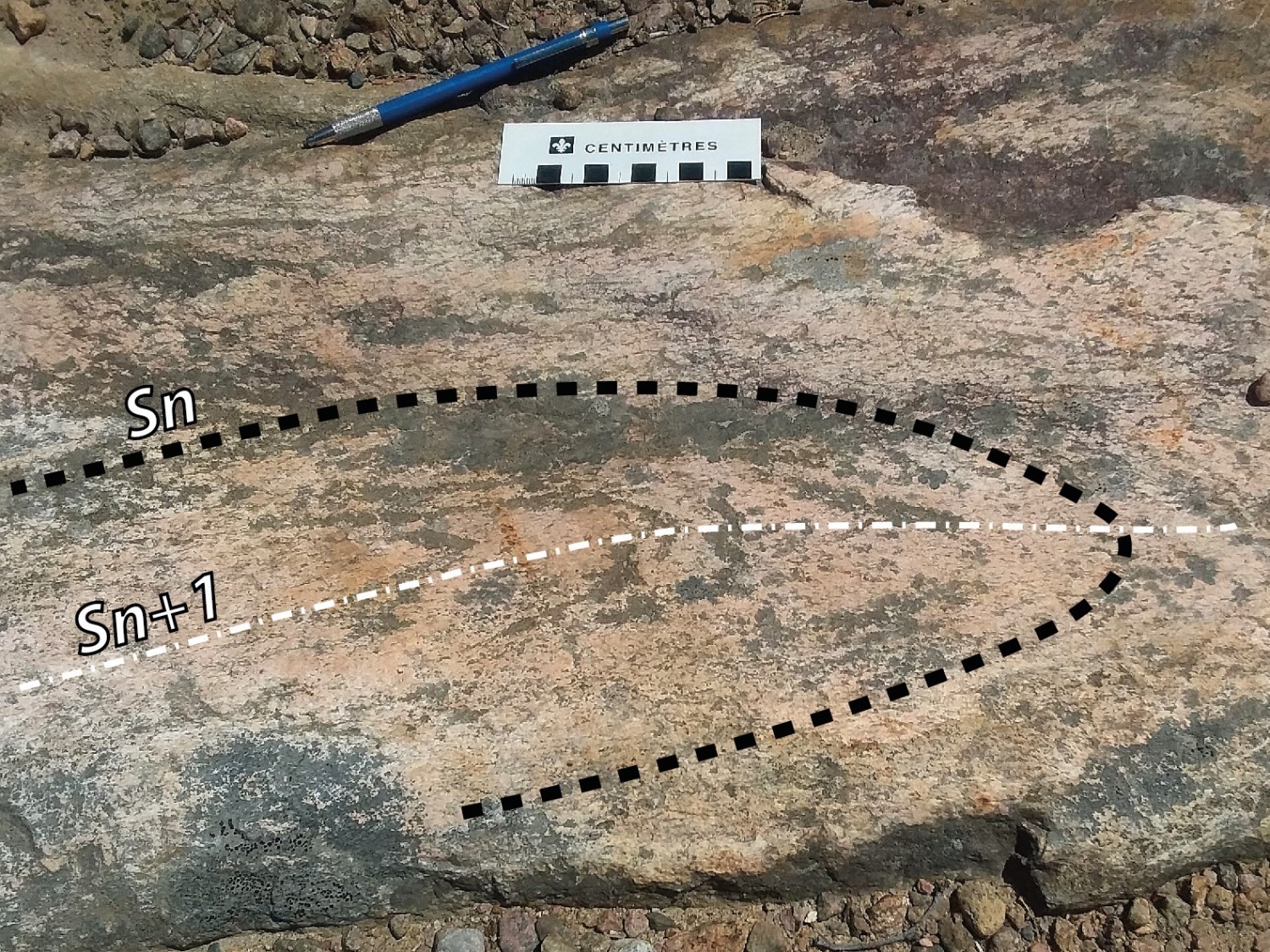
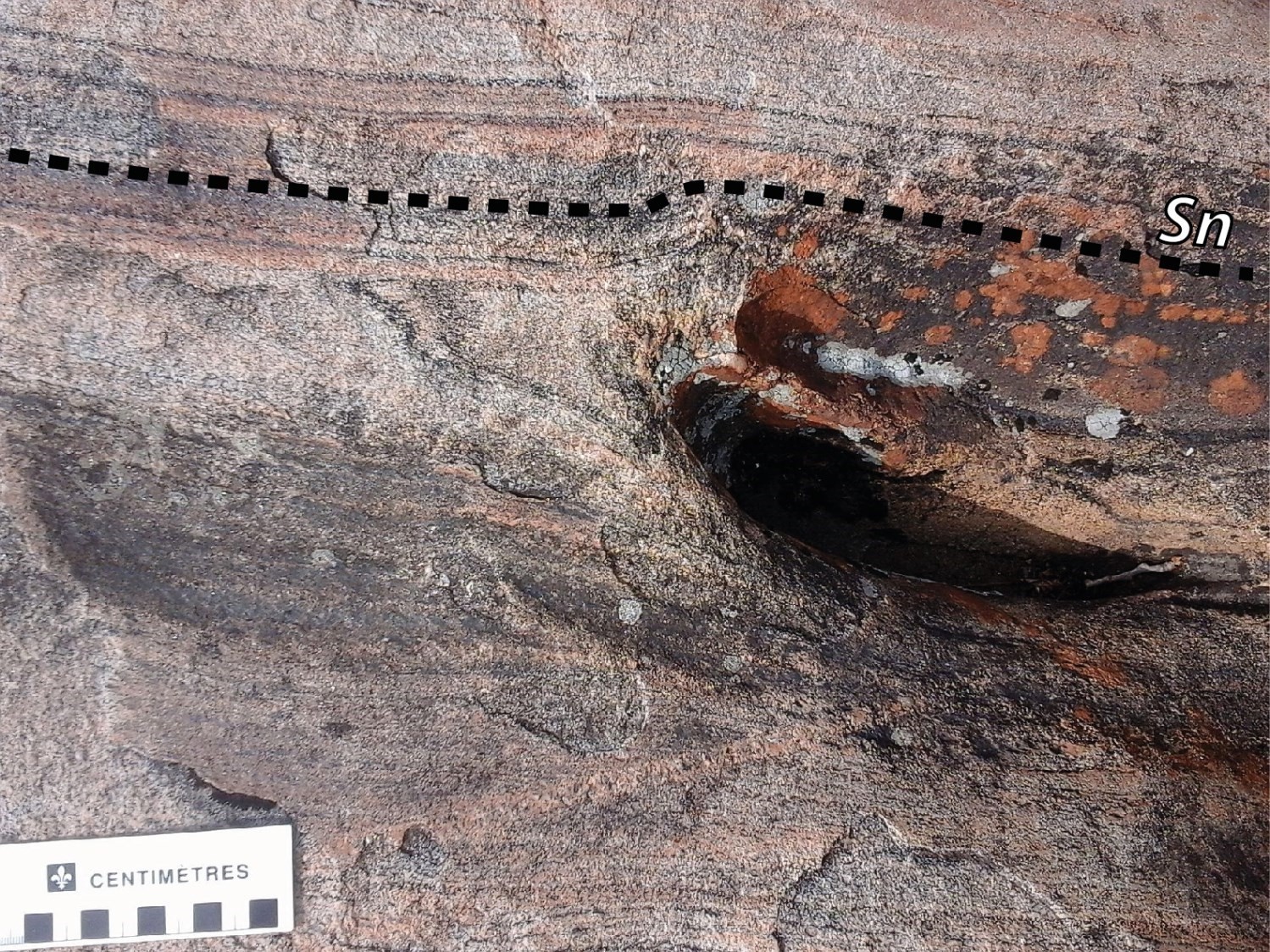
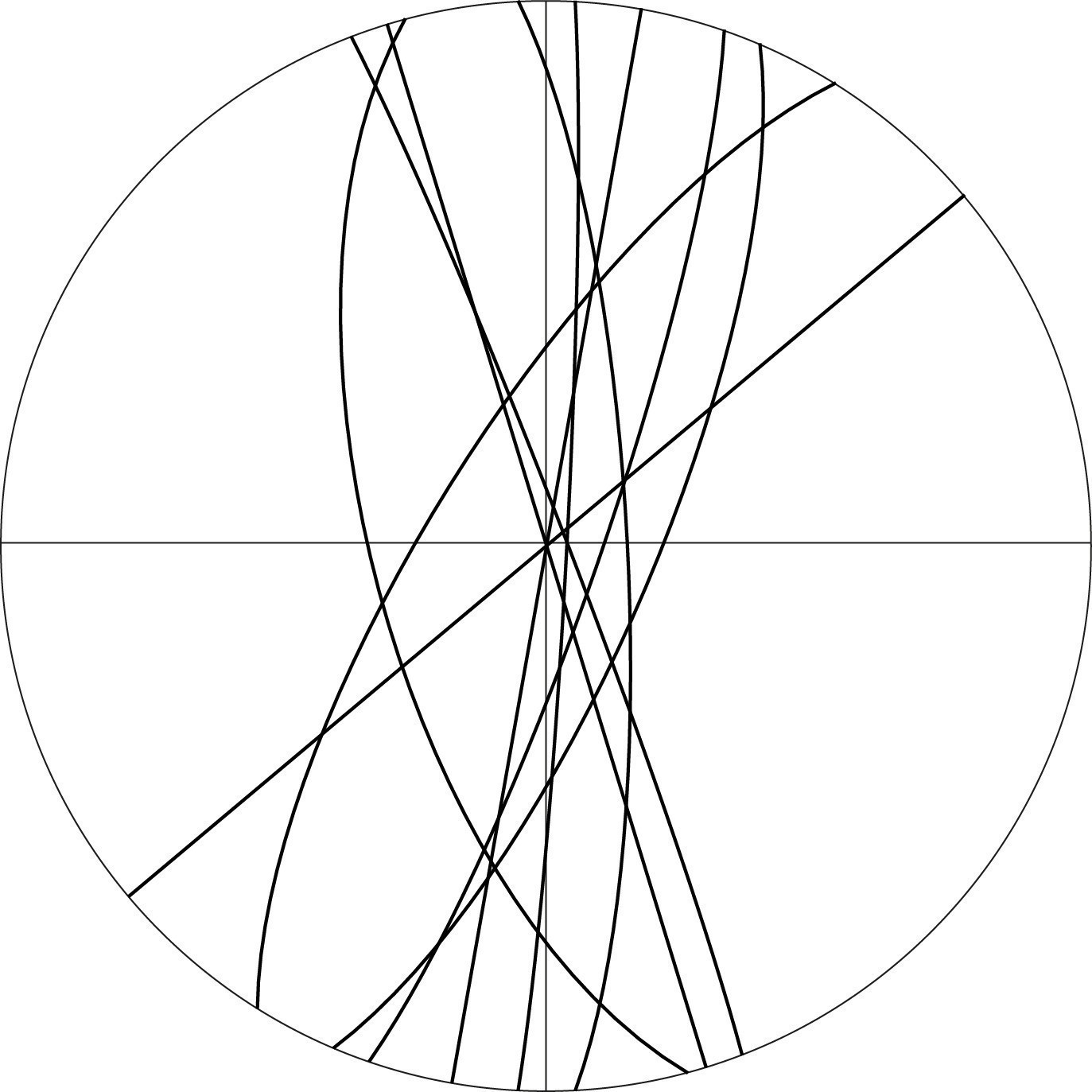
Gneissosity and migmatitic banding are commonly folded and locally cut by a Sn+1 foliation that appears to be roughly parallel to the Pn+1 antiform axial plane trace (see adjacent photo). This foliation is relatively discreet and can be confused with the Sn foliation oriented N-S. Nevertheless, in Pn+1 hinges, both fabrics are oblique and therefore clearly identifiable. The Sn+1 foliation is emphasized by directional flattening and elongation of quartz grains and ferromagnesian mineral clusters (biotite and amphibole). A limited number of Sn+1 measurements have been collected, but their stereographic projection shows that the Sn+1 foliation is generally oriented NNE-SSW and its dip is typically >70°.
| Main Fabric | Type of fabric | Direction (°) | Dip (°) | Number of Measurements | Comments |
| Foliation Sn+1 | Secondary tectonometamorphic mineral foliation | NNE-SSW | 64-90 | 10 | Measurements from sheets 32A02 and 32A07 |
❯ Folds
The Sn foliation trajectory inferred from field data and interpretation of geophysical lineaments derived from the analysis of total magnetic field maps and their derivatives (Intissar and Benahmed, 2015) seems to show that the Ministic Structural Domain is affected by at least two folding phases.
The first phase of folding is marked by the presence of a large Pn+1 antiform, whose axial plane trace is generally oriented N-S. Although this has only been reliably drawn in the SW and NW corners of sheets 32A02 and 32A07 respectively, the antiform actually appears to continue across the width of sheets 32A02 and 32A07. The mean axial-plane dip of this antiform can be inferred from the Sn foliation attitude observed in the sector. This dip appears to be moderate to steep and oriented eastward. The Pn+1 antiform of sheets 32A02 and 32A07 appears to be overturned westward.
In the SW corner of sheet 32A02, the Pn+1 antiform trace is folded by tight Pn+2 folds, of kilometric wavelength and amplitude. These folds are oriented NE-SW and the attitude of Sn foliation, located on either side of axial plane traces, suggests that they are generally overturned westward. The Rhéaume Intrusive Suite occupies the central part of a Pn+2 antiform. Folds having similar attitude (shape, wavelength and amplitude), interpreted as Pn+2, are also present east of the Bonhomme Plutonic Suite (sheet 32A07) and in the northern part of the Léo Plutonic Suite (sheet 32A10). However, they have an ENE-WSW orientation, slightly oblique to those of the Pope Plutonic Suite, but which also seem to be overturned towards the NW. In sheet 32A03, folds of the same generation are generally overturned towards the NW.
Geometric Parameters of Regional Folds:
| Fold or Family of Folds | Type (Anticline, Syncline or Undetermined) | Shape (Antiform or Synform) | Attitude (Overturned or Upright) | Axial Plane | Fold Axis | Position (Certain or Probable) | Deformation Phase | Comments | ||
| Direction | Dip | Direction | Dip | |||||||
| Fold Pn+1 | – | Antiform | Overturned westward | N-S | 50-70° | – | – | Certain | Pn+1 | A large N-S orientation antiform appears to extend in the entire structural domain in sheets 32A02 and 32A07, east of the Bonhomme Plutonic Suite |
| Family Pn+2 | – | Antiform and synform | Overturned towards the NW | NE-SW and ENE-WSW | ~60-65° | – | – | Certain | Pn+2 | Two axial plane traces recognized in the SW corner of sheet 32A02, in the Pope Plutonic Suite and Rhéaume Intrusive Suite, and several axial plane traces identified in the southern part of sheet 32A07 (NW of the Marianne Plutonic Suite) and in sheet 32A03 (Pope Plutonic Suite) |
❯ Crosscutting Relationships
In sheets 32A02, 32A03, 32A07 and 32A10, the Ministic Structural Domain is cut by a number of faults inferred from high-definition magnetic field maps (Intissar and Benahmed, 2015). These faults appear to be divided into two families. One is oriented NE-SW and involves dextral strike-slip faults (interpreted in the NW corner of sheet 32A07); the other is oriented NW-SE and consists of sinistral strike-slip faults (interpreted in the southern part of sheet 32A02, the eastern part of sheet 32A03 and the SW part of sheet 32A10). This family of faults also cuts the Commissaires Structural Domain.
Geometric Parameters of Regional Faults Cutting the Ministic Structural Domain:
| Fault or Family of Faults | Type | Mean Direction (°) | Mean Dip (°) | Lineation Plunge in the Fault Plane | Estimated Width (m) | Estimated Length (km) | Apparent Movement | Position | Comments |
| Family of NE-SW faults | Regional faults | NE-SW | Subvertical | – | – | 4.5-10 | Dextral | Inferred from geophysical surveys | Small kilometric faults cutting the Bardeau Plutonic Suite in the NW corner of sheet 32A07 |
| Family of NW-SE faults | Regional faults | NW-SE | Subvertical | – | – | 2.7-6 | Sinistral | Inferred from geophysical surveys | Interpreted in the SW corner of sheet 32A02 |
❯ Kinematics
Does not apply.
Deformation Style
The Ministic Structural Domain shows polyphase deformation and at least two regional folding phases. The Sn foliation, which is expressed by gneissosity in the Pope, Léo and Bardeau plutonic suites and migmatitic banding in paragneiss of the Barrois and Wabash complexes, was folded for the first time during a Dn+1 deformation event. This appears to be associated with an E-W shortening phase. Subsequently, the Pn+1 antiform is locally overprinted by kilometric open Pn+2 folds. The overall NE-SW orientation of these Pn+2 folds then suggests a NW-SE shortening phase.
Metamorphic Characteristics
Approximately 40 representative rock samples were studied under a polarizing microscope to establish the metamorphic characteristics of the Ministic Structural Domain. Mineralogical and structural observations indicate that metamorphic conditions within the domain are distributed between the amphibolite and granulite facies.
Felsic to intermediate intrusive rocks of the Bonhomme and Léo plutonic suites commonly show quartz-plagioclase-K-feldspar-orthopyroxene-hornblende-biotite assemblages. Locally, the presence of garnet may be observed. These rocks, whose diffuse foliation is often weakly expressed and marked by the preferential orientation of ferromagnesian minerals, are characterized by a coarse grain size and an interlobed heterogranular texture. Indeed, the border between quartz and feldspar grains is often clearly rounded, suggesting a process of dynamic recrystallization at high temperature (Gower and Simpson, 1992). The frequent presence of myrmekite grainsdeveloped near the edges of K-feldspar porphyroclasts, the abundance of flame-like perthite in these clasts, and the chessboard texture of quartz grains indicate temperature conditions of at least 600°C during deformation (Blumenfeld et al., 1986; Gapais and Barbarin, 1986; Simpson and Wintsch, 1989; Pryer, 1993).
Around the Bohomme and Léo plutonic suites, rocks of the Bardeau Plutonic Suite and Barrois and Wabash complexes instead show mineralogical assemblages typical of amphibolite facies metamorphic conditions. In fact, aluminous metasedimentary rocks studied under the microscope have biotite-garnet-sillimanite-muscovite assemblages, whereas intermediate intrusive rocks observed show an assemblage of biotite-hornblende ferromagnesian minerals, and the absence of pyroxene.
Alterations
Does not apply.
Geophysical Characteristics
In sheets 32A02, 32A03, 32A07 and 32A10, the high-resolution total magnetic field map (Intissar and Benahmed, 2015) shows a pattern mostly dominated by curvilinear magnetic lineaments and generally strong susceptibility with little contrast. In some areas, particularly those where the Pope, Bonhomme and Léo plutonic suites overlap, show lobed or elliptical patterns with overall moderate to intense magnetic susceptibility. Elsewhere, the magnetic pattern is more banded, but lineaments are curvilinear. These areas approximate overlapping zones of the Bardeau Plutonic Suite and Barrois and Wabash complexes.
Chronological Markers
In the Wemotaci area, graphite paragneiss from the Wabash Complex provided a maximum depositional age of 1204 ±2 Ma (Moukhsil et al., 2015), implying that the Dn migmatization and regional deformation of these rocks are younger than ~1.2 Ga. In addition, a syenite from the Rhéaume Intrusive Suite was dated by U-Pb zircon method at 985.3 ±9.3 Ma (Côté et al., 2018). This intrusive suite forms an ellipse with a long axis overlapping with a Pn+2 axial plane trace. This suggests that the Dn+2 regional deformation is either younger or contemporaneous to the Rhéaume Intrusive Suite emplacement.
References
Publications available through Sigéom Examine
INTISSAR, R., BENAHMED, S. 2015. LEVÉ MAGNÉTIQUE AÉROPORTÉ DANS LE SECTEUR OUEST DU LAC-ST-JEAN, PROVINCE DE GRENVILLE. MERN, GOLDAK AIRBORNE SURVEYS. DP 2015-06, 7 pages and 2 plans.
MOUKHSIL, A., SOLGADI, F., BELKACIM, S., AUGLAND, L E., DAVID, J. 2015. GÉOLOGIE DE LA RÉGION DE PARENT, HAUT-SAINT-MAURICE (PARTIE OUEST DU GRENVILLE). MERN, UQAT-URSTM, GEOTOP-UQAM-MCGILL. RG 2015-04, 62 pages and 1 plan.
MOUKHSIL, A., DAOUDENE, Y. 2019. Géologie de la région du lac des Commissaires, Province de Grenville, région du Saguenay–Lac-Saint-Jean, Québec, Canada. Ministère de l’Énergie et des Ressources naturelles, Québec; BG 2019-01.
MOUKHSIL, A., EL BOURKI, M., 2020. Géologie de la région de Normandin, Province de Grenville, région du Saguenay–Lac-Saint-Jean, Québec, Canada. MERN; BG 2020-01.
MOUKHSIL, A., SOLGADI, F. 2018. Géologie, potentiel minéral et cadre géodynamique des roches de la région du réservoir Daniel-Johnson (Manicouagan), partie centrale de la Province de Grenville. In: MOUKHSIL, A., SOLGADI, F., JANNIN, S., GERVAIS, F., CROWLEY, J.L., AUGLAND, L.E., INDARES, A., LÉTOURNEAU, M., DUNNING, G., CLARK, T., GOBEIL, A., OHNENSTETTER, D., LAMOTHE, D., INTISSAR, R., BENAHMED, S., GROULIER, P.A. GÉOLOGIE, POTENTIEL MINÉRAL ET CADRE GÉODYNAMIQUE DES ROCHES DE LA RÉGION DU RÉSERVOIR DANIEL-JOHNSON (MANICOUAGAN), PARTIE CENTRALE DE LA PROVINCE DE GRENVILLE. MRN. MM 2017-01, pages 7-92.
TALLA TAKAM, F., MOUKHSIL, A., 2023. Géologie de la région du lac de la Fourche, Province de Grenville, région du Saguenay–Lac-Saint-Jean, Québec, Canada. MERN; BG 2023-02, 1 plan.
Other publications
BLUMENFELD, P., MAINPRICE, D., BOUCHEZ, J.L. 1986. C-slip in quartz from subsolidus deformed granite. Tectonophysics; volume 127, pages 97–115. doi:10.116/0040-1951(86)90081-8.
CÔTÉ, G., MOUKHSIL, A., CONSTANTIN, M., DAVID, J. 2018. Geochemical characterization, geochronology, and geodynamic implications of Grenville rare earths bearing syenite, Haut-Saint-Maurice, QC, Canada. Minerals; volume 8, page 336. https://doi.org/10.3390/min8080336.
GAPAIS, D., BARBARIN, B. 1986. Quartz fabric transition in cooling syntectonic granite (Hermitage massif, France). Tectonophysics; volume 125, page 14. doi:10.1016/0040-1951(86)90171.
GOWER, R.J.W., SIMPSON, C. 1992. Phase boundary mobility in naturally deformed, high-grade quartzofeldspathic rocks: evidence for diffusional creep. Journal of Structural Geology; volume 14, pages 301–313. doi:10.1016/0191-8141(92)90088-E.
PRYER, L.L. 1993. Microstructure in feldspars from a major crustal thrust zone: the Grenville Front, Ontario, Canada. Journal of Structural Geology; volume 15, pages 21–36. doi:10.1016/0191-8141(93)90076-M.
SIMPSON, C., WINTSCH, R.P. 1989. Evidence for deformation-induced K-feldspar replacement by myrmekite. Journal of Metamorphic Geology; volume 7, 15 pages. https://doi.org/10.1111/j.1525-1314.1989.tb00588.x.
Suggested Citation
Ministère de l’Énergie et des Ressources naturelles (MERN). Domaine structural de Ministic. Lexique structural du Québec. https://gq.mines.gouv.qc.ca/lexique-structural/domaine-structural-de-ministic [cité le jour mois année].
Contributors
|
First publication |
Abdelali Moukhsil, P. geo., Ph. D. abdelali.moukhsil@mern.gouv.qc.ca; Yannick Daoudene, P. geo., Ph. D. yannick.daoudene@mern.gouv.qc.ca (redaction) Ghyslain Roy, P. geo. (coordination); Fabien Solgadi, P. geo., Ph. D. (critical review); Simon Auclair, P. geo., M. Sc. (editing); Ricardo Escobar (HTML editing); Céline Dupuis, P. geo., Ph. D. (English version) |
|
Revision(s)
|
Mhamed El Bourki, P. geo., M. Sc. mhamed.elbourki@mern.gouv.qc.ca (redaction) (26/03/2020) Ghyslain Roy, P. geo (coordination); Fabien Solgadi, P. geo., Ph. D. (critical review); Simon Auclair, P. geo., M. Sc. (editing); André Tremblay (HTML editing); Céline Dupuis, P. geo., Ph. D. (English version);
|
|
Francis Talla Takam, P. geo., Ph. D. francis.tallatakam@mern.gouv.qc.ca; Abdelali Moukhsil, P. geo., Ph. D. abdelali.moukhsil@mern.gouv.qc.ca (redaction) (23/03/2023) Hanafi Hammouche P. geo., M. Sc. (coordination); Mhamed El Bourki, P. geo., M. Sc. (critical review); Simon Auclair, P. geo., M. Sc. (editing); André Tremblay (HTML editing); Catherine Tremblay (English version) |